The answer
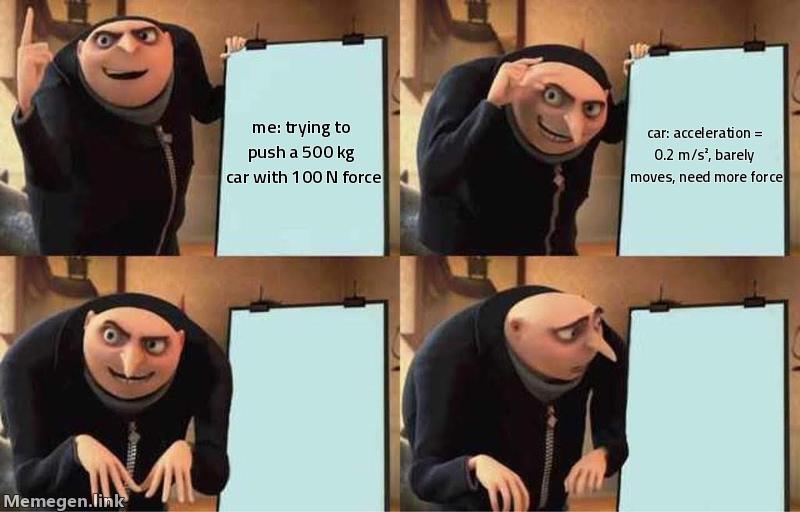
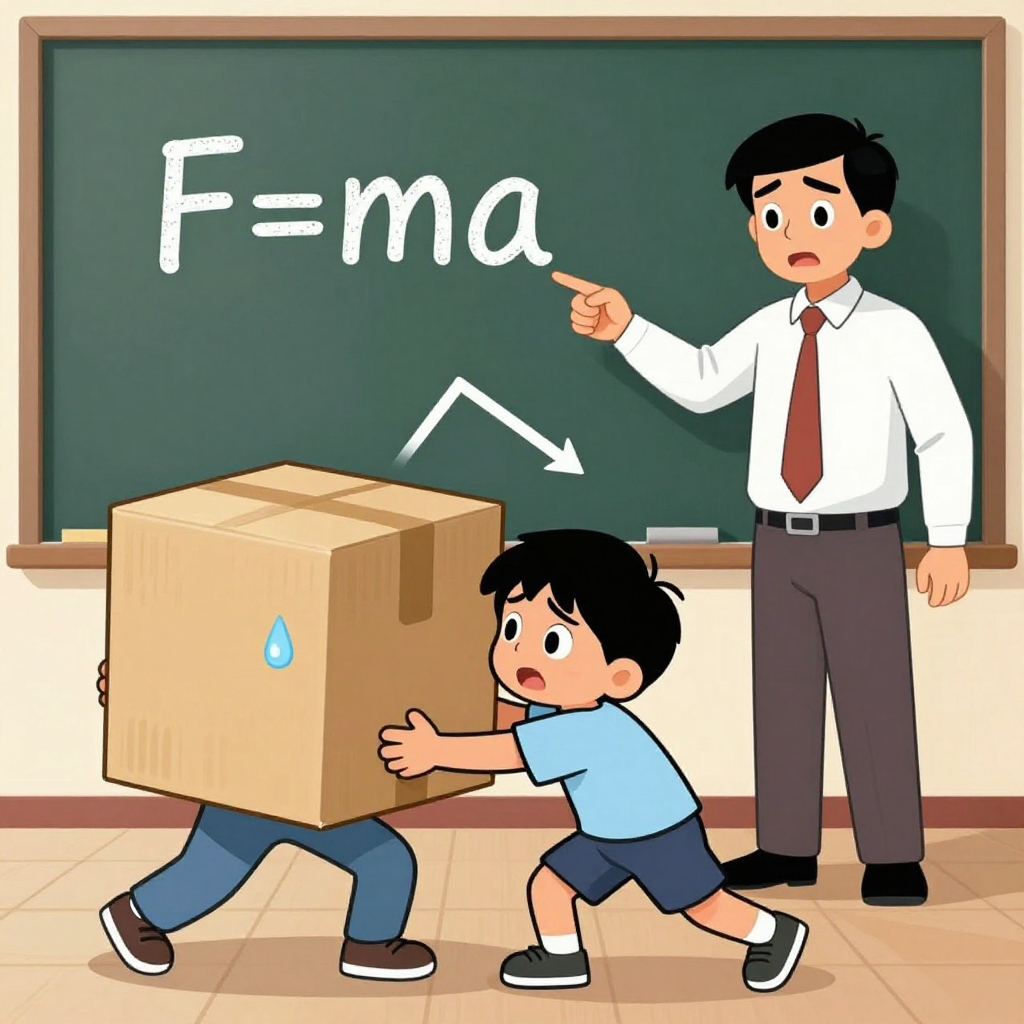
Newton's second law states that the net force acting on an object is equal to the rate of change of its momentum. In simpler terms, the acceleration of an object is directly proportional to the net force applied and inversely proportional to its mass. The formula is , where F is the net force in newtons (N), m is the mass in kilograms (kg), and a is the acceleration in meters per second squared (). This law tells us that a heavier object needs more force to accelerate at the same rate as a lighter one.
To use this law, remember to find the net force first (vector sum of all forces) and then plug into . For example, if you push a 5 kg box with a force of 20 N and friction opposes with 5 N, the net force is N. Then acceleration is . This means every second, the box's speed increases by 3 m/s.
A common exam trap: if you double the force, acceleration doubles; if you double the mass, acceleration halves. Also, the unit of force is such that N = kg·m/s². Always convert grams to kg (divide by 1000) before using the formula. For example, a 500 g object has kg.
Worked numerical: A car of mass 1200 kg accelerates from rest to 20 m/s in 10 s. First, find acceleration: . Then net force: N. So the engine must provide 2400 N to achieve that acceleration (ignoring friction). This is a classic question – make sure you use to find acceleration first.
In exam, always draw a free-body diagram to identify all forces, then apply . Remember, if the object moves with constant velocity, , so net force is zero – that's the first law's special case.